
‘Save the ArQ’ in Jerusalem is a story of nonviolent resistance
In the walled-in Old City of Jerusalem, in the Armenian Quarter, sits a large pile of rubble with an Armenian flag planted at the top. This pile of rubble, the flag, and the Armenian Quarter itself all tell a story of resistance and nonviolence.

This past October, I traveled to the West Bank with a group of writers and journalists, hosted by Sabeel, an ecumenical Palestinian Christian liberation theology organization. During the 10 days we were there, our group met with so many people—artists, faith leaders, families, activists, farmers, students—and heard their stories. We stayed in East Jerusalem and Ramallah and traveled to different towns, such as Bethlehem, Taybeh, and Umm al-Khair.
In occupied East Jerusalem, Palestinians face home demolition orders, eviction notices, and policies on behalf of Israeli forces and settler organizations that make life there extremely difficult. So many of the people we met had experienced settler and state violence.
With the many forces that seek to remove Palestinians from Jerusalem, Omar Haramy, one of the leaders of Sabeel, wanted to tell us the story of a recent movement in the Armenian Quarter called Save the ArQ. Led mostly by young people and teenagers, the Armenian community was able to stand up to an illegal land grab and win at keeping the land that they’ve held for 700 years in the Old City.
The Old City of Jerusalem is divided into four quarters: Muslim, Jewish, Christian, and Armenian. To get to the area known as Cows’ Garden in the Armenian Quarter, we walked through Jaffa Gate into the Old City and through narrow streets. Once there, we saw the pile of rubble and stood next to a section of the ancient Old City wall, as thick as it is tall, weeds exploding out of it.
Armenia was the first kingdom to adopt Christianity in the fourth century, and Christians there soon started a tradition of going on pilgrimage to the Holy Land. Throughout the years, many Armenians relocated to the Holy Land, establishing a strong Armenian presence in Jerusalem. After the Armenian genocide in 1915, a new wave of Armenians came to Jerusalem; now there are around 1,000 Armenians who live in the Old City.
The Armenian Gardens, or Cows’ Garden, is on Mount Zion. In recent years, the Armenian Quarter has been a target of settler attacks, “assaults on clergy through spitting and beatings, graffiti on the walls of the quarter calling for death to Arabs, Christians, and Armenians, and verbal abuse of Armenians in the streets as they try to walk home. Indeed, this is but a microcosm of wider assaults on Christian presence in Jerusalem,” writes Kegham Balian in an article in Jerusalem Quarterly.
In 2021, a private Israeli company, Xana Gardens, made a deal with Armenian church leaders to lease Cows’ Garden so they could build a luxury hotel. Local Armenians started Save the ArQ to stop the deal and preserve the history and heritage of the Armenian Quarter.
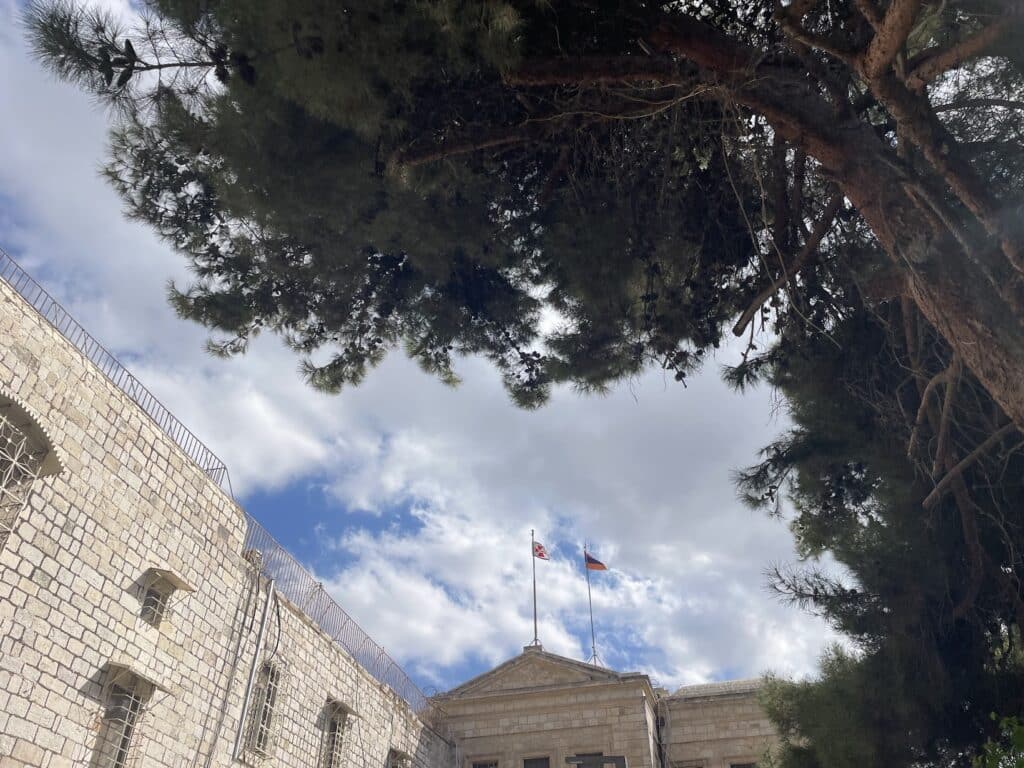
The Save the ArQ community protested weekly. In 2023 the Armenian Patriarch canceled the deal with Xana Gardens. However, that fall, bulldozers and armed Israeli settlers came into Cows’ Garden and bulldozed part of the property to attempt to seize it.
Standing their ground at Cows’ Garden through rain and harsh weather, a group of young Armenians resisted the multi-million dollar company, bulldozers, and settlers with weapons. Community members brought them food and created a makeshift tent.
In December 2023, they successfully drove away the bulldozers and challenged the Xana Gardens deal, saving Cows’ Garden and the heritage and future of the Armenian Quarter.
The pile of rubble with the flag on top was caused by the bulldozers. “Atop a pile of tarmac and wreckage amassed by the bulldozers of our oppressors, we raised the flag of Artsakh,” Balian wrote.
“This is maybe the only battle that we have won against settlers: It was won by a group of amazing creative young Christian folks,” Haramy said. “They stood hand in hand and they liberated the piece of land.”
The young people found pro-bono lawyers to help translate documents from the Ottoman period to prove the land belonged to the community. They learned the piece of land wasn’t sold to the church 700 years ago, it was sold to the Armenian community, so they had grounds to fight the deal. “It’s like a miracle,” Haramy said. “Was it the Holy Spirit?”
In a large makeshift structure on the property, we met with a few folks from Save the ArQ. Inside the tent they set up a table, a small kitchen, and some couches. A cross hangs from one end. They want the international community to know about their struggle.
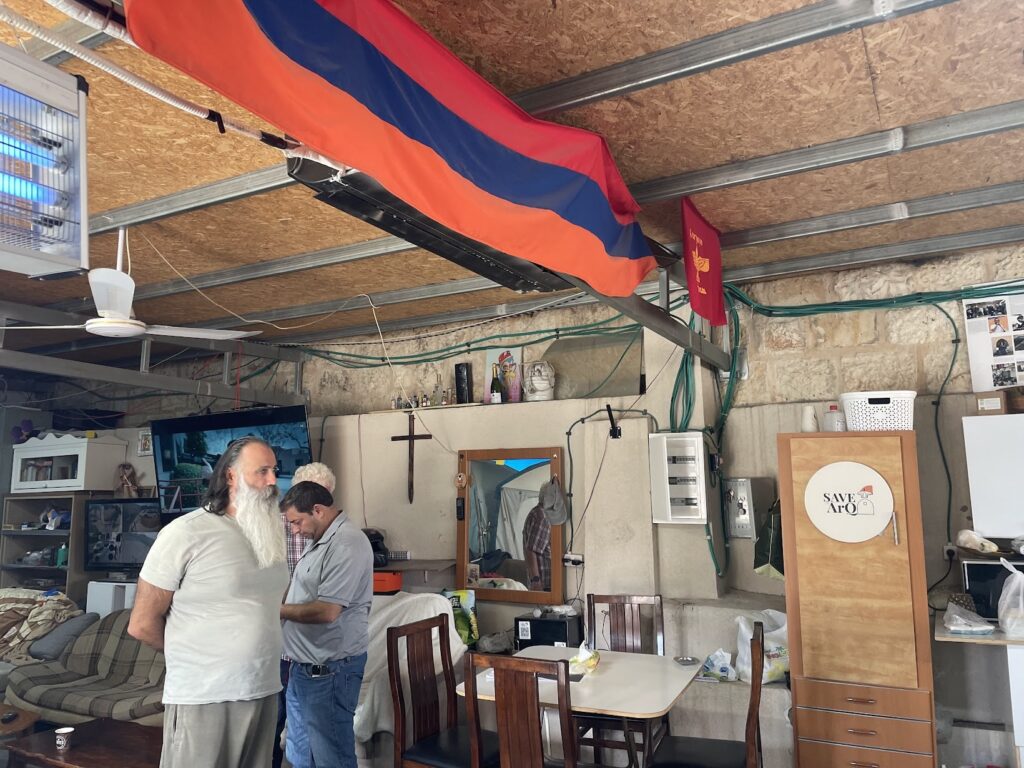
“Jesus in the Beatitudes says the weak shall inherit the earth, and the weakest within the community are the ones who remain” fighting injustice, Haramy said. “Empire has no chance against the people.”
Cows’ Garden is “a place of hope,” Haramy said. “It’s a place of strength. It’s one of the successes of how through nonviolence, communities are able to liberate their land. The battle still goes on. It’s not easy to be a Palestinian and to be here doing what we were doing.”
My trip to the West Bank has taught me a lot about the risk, mess, and life-giving demands of discipleship. Hearing the story of the young people standing up to empire and violence in solidarity was a powerful lesson in what it means for my own faith to give me courage and take risks for justice. What it means to be a person of faith in the Holy Land, and everywhere, is practicing solidarity, giving and taking courage in community, and taking risks for love of our neighbors.
To read more by this author, visit our web site.
ABOUT THE AUTHOR

Cassidy Klein is a journalist, writer, and editor based in Chicago. She has worked as an editorial assistant at Sojourners magazine and U.S. Catholic magazine. She grew up in Denver, Colorado and studied journalism and philosophy at PLNU in San Diego. Find more of her work at cassidyrklein.weebly.com.


