“Your ordinary acts of love and hope point to the extraordinary promise that every human life is of inestimable value.”
– Desmond Tutu
I was solo parenting on Sunday. My husband and son were out of town. I was flanked by daughters Nim, six, lolling around in the pew to my left and asking “when’s bread?” and Pen, nine, to my right, grabbing a pencil and prayer request sheet as she’d seen me do to jot down some notes. Our pastor was highlighting the life of Dietrich Bonhoefer, who lived through the rise of the Third Reich and died at the hands of the state because of his resistance to their genocidal ways.
I noted that Bonhoefer believed it was the duty of the church to not only tend to the wounds of the oppressed, but to meet injustice at its root; that silence is complicity and neutrality is an impossibility. He believed, I wrote, that the church is to stand with the marginalized and be prepared to pay the cost. On her paper Pen wrote, “Bonhoefer taught us to always tell the truth no matter what.”
Photo by the author.
After church, I took the girls to the farmers market. It’s that time of year when the market explodes with color and fragrance. Most importantly, it’s peach season, which is like a kind of holiday to us. I remind the girls how to select the most delicious fruits, gently checking the skin for breaks or bruises and breathing in deeply for that scent of sweetness.
Near the checkout counter, we were captivated by a display case of handmade goods, including beautifully printed, aromatic soaps. Nim chose a bar of intricate pink roses and Pen a blue-green garden scene with a butterfly. In the car, I passed the phone back so they could document these unexpected treasures.
During the drive home, I relished the sound of their oo-ing and ah-ing and joking and joy. I thought, I wish everyone could be this rich. Rich enough to have more than their basic needs met; enough to enjoy the luxury of buying peaches even if they are $2.49 a pound and then to see something beautiful and extravagant and be able to say, yes.
“What does it mean to be a moral person in this upside down world?”
The next day, I was listening to the radio on the way to the school where I work as a reading coach. I heard the news that an air force training jet in Bangladesh crashed into a school and killed at least twenty people, with many more injured, most students. Is there a phrase more chilling than, “killed at least”?
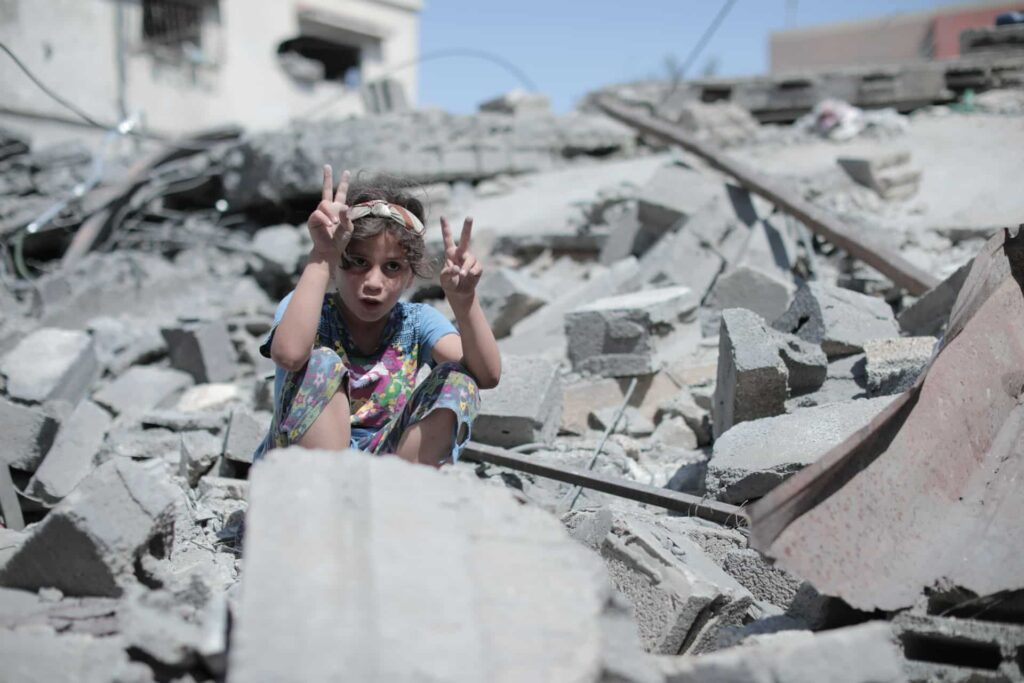
News of deaths at a school have a different kind of weight, suffocating and heavy. Children broken, bruised, and bloodied. Children who we are meant to keep safe. Whether it’s a horrific accident like this, or a horrific recurring event like the chronic mass shooting in the US, or the targeted bombings of schools and shelters in Gaza, a child dying is not an abstraction. A James Baldwin quote articulates my feeling more perfectly than I know how, “The children are always ours, every single one of them, all over the globe; and I am beginning to suspect that whoever is incapable of recognizing this may be incapable of morality.”
The day’s news was a one-two punch with the next story being on the latest US-backed Israeli attacks on Palestinians seeking aid in Gaza. Perhaps right there is the more chilling phrase, “killed seeking aid.” Over the last year, I’ve watched daily life there play out more grotesquely than any horror film. I see children dying every day, turning the screen quickly away as my six-year-old peers over my shoulder and asks, “what are you watching?”
I feel almost like I live parallel lives. One tuned into and preoccupied with a humanitarian crisis more relentless and devastating than I could have ever imagined. So awful, I cannot conjure adequate words. The other, a simple, mostly sweet existence; marveling at the miracle of food from our garden and morning snuggles with my three children, tinkering with new literacy techniques for my students and reffing sibling squabbles.
I’ve struggled to know how to respond to the indescribable suffering. I want to tell the hard truth to my kids yet also to shield them from trauma and protect their precious, fleeting childhood. I donate money to soup kitchens, not knowing if it’s of any value–was the food I helped purchase left to rot, prohibited, along with baby formula and medical supplies, from crossing the border to reach the hungry and wounded while the US and IDF dole out murder and manipulation in the guise of aid? What does it mean to be a moral person in this upside down world?
The late John Lewis is known for saying that at such a time as this, people of faith are called upon to make “good trouble.” But what can I do, when the problem is so far away, and yet, so embedded into the politics and business and even religious life here in the US, the country that provides the bombs and the money and the political shield that makes it all possible?
Photo by the author.
I can pray, of course, but it’s been a minute since I’ve believed in an interventionist God. Maybe a God who might stir the spirits of those who are meant to be the body of Christ – those hands and feet that have been explicitly instructed to give bread and water to such as these. And not to kill.
One thing I definitely believe is my image is not more of God, nor is my life or my children’s lives more precious than anyone, anywhere. I am not more worthy than any other because of the circumstances of my birth. There isn’t any reason I am more entitled to this tender moment, to this breath, to kiss my kids goodnight. I think anyone who supposes there are certain lives that are more significant than others are supposing out of fear or guilt so they don’t have to be confronted with the sacredness of every life.
And with good reason, it is a frightful and a shameful thing to know that we are all equally worthy of sustenance, love, comfort; of death too when it comes to it. Because there they are–the other mothers–watching their children’s soft faces turn sharp and sallow, listening to as their breath grows shallow.. And here I am, buying sweet, fresh peaches and fancy soap; listening to my boisterous, rosy-cheeked daughters laugh.
Amy Nee-Walker grew up in the middle of a large and lovely family in Central Florida. Living into questions about truth and love has led her to the Catholic Worker Movement, the Catholic Church, her incredible husband, three audacious, adorable children, and (for the time being) a home in the hills of Appalachia.
“There’s nothing that I wouldn’t give to just tear that wall down.” – Sister Tracey Horan Season 4, Episode 3 of Messy Jesus Business podcast, hosted by Sister Julia Walsh. LISTEN HERE: IN THIS EPISODE: In this episode of Messy Jesus Business, Sister Julia Walsh talks with Sister Tracey Horan about her journey from being…
A few weeks ago, one of my cousins committed suicide. It was a shock to all of us who knew and loved him. His death still remains sad and painful for many of us. Personally, the experience of suffering with my family taught me much about the power of God’s love. In a new way…
Days ago, Christians gathered in Churches around the world and chanted a summons to the sweet, Holy Spirit. Veni Sancte Spiritus. Days ago plus today and tomorrow, we fill(ed) the streets with chants of lament and outrage. We pray, we chant. We cry for raids to end. We risk arrest while neighbors and friends— blessed…
It is common for white people to not know where to start when it comes to discussing racism. There are academics literally studying white culture and white fragility; why we white folks have such a difficult time talking about racism and why we have an even more difficult time addressing our role in it. For…
I was first introduced to Pierre Teilhard de Chardin’s cosmology at a bar in Wisconsin. I was a recently graduated senior out to eat with my parents, drinking a beer in public for the first time. I was still 18, but in western Wisconsin the legal drinking age is as obfuscated as Teilhard’s arduous writing….
Recently I spent several weeks out of town, as a guest in the home of some of my friends. A family member had a major surgery and it was a privilege to be present during the recovery. I decided to walk to the local Catholic Church and attend daily mass – nothing too unordinary for…