
Bumbling Toward the Economy of Francesco
For over a year we met obstacles from all sides as we tried to get our six lender families on the same page for a date to go out to the farm.
Some of us friends had joined our collective capital toward a peer-to-peer loan for a local farm and our ‘return on investment’ was a farm-to-table meal on site.

But then there were soccer games, birthday parties, work schedules, the ebb and flow of interest in following up, and seasonal weather delays. After several months, it was easy to imagine it not happening. The web of relationships in community life is complex. It can be quite inefficient and inconvenient. It can be a bit messy.
Contrasting this inefficiency with the streamlined user-friendly convenience of an abstracted investment experience with your large-scale broker or in-your-pocket app could make the dominant financial mechanisms more appealing…or at least much easier. Relational economic practices, when they hit the ground, are anything but neat and tidy.
On the Memorial of Saint Joseph the Worker – May 1, 2019 – Pope Francis wrote a letter exhorting young economists and entrepreneurs from all around the world to “give a new soul to the economy of tomorrow.” He provokes reflection, prayer, and action toward a more human, fraternal economic imagination that centers justice for the poor, including the earth as our ‘common home.’ This invitation continues to sow seeds of creative, collaborative, relational economic experiments all over the world.
By the time of the inaugural Economy of Francesco gathering in Assisi in 2020 (in response to Pope Francis’ letter), a group of us in Durham had been sharing life together in varied forms for many years. We were joining each other in patterns of prayer and care and eating alongside ‘clarification of thought’ conversations around daily discipleship practices that involved technology, crafting, sabbath, and our household economic lives. These conversations formed the soil from which our Common Good Fund grew – this small step to pool some money together each month to circulate toward a more just and relational economy. Without awareness of Pope Francis’ provocation to “re-animate the economy,” we were being shepherded by the same Spirit, learning about local alternative expressions of a solidarity economy.
As one aspect of this communal learning, we were inspired by the framing of investment offered by another Pope, John Paul II, “…to give others the opportunity to make good use of their own labor.” What would it mean if we thought of investment in terms of vocational hospitality? Rather than the extractive conventional logic of maximizing financial return, what if our investments played a small part in making room for others to freely live their vocation and offer their labor for the common good? We stayed alert on how to orient our investments toward dignifying the labor of our neighbor, keeping our antennae up for a chance to do just that with our collective resources.
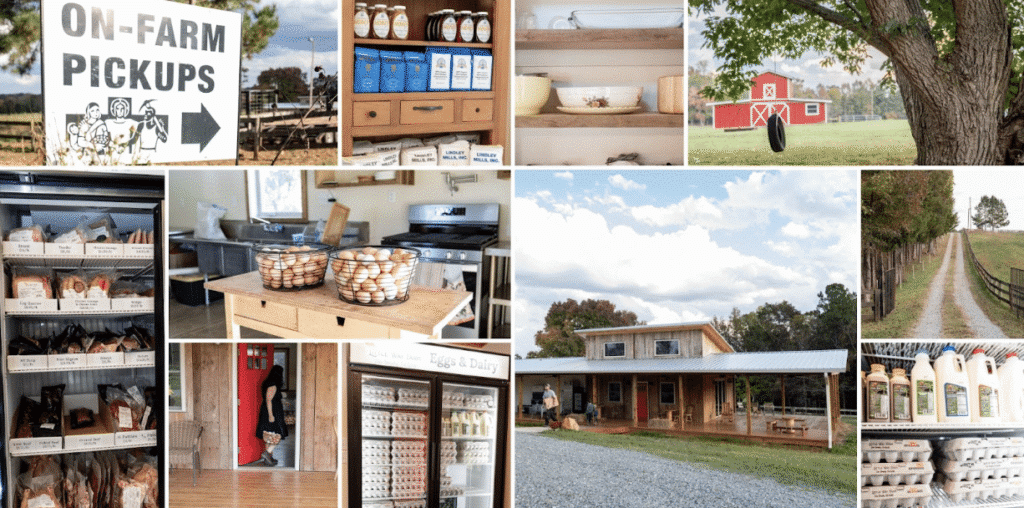
An opportunity arose with a friend, Joe — an Episcopalian priest and the operator of Little Way Farm. Rooted in the formation that animated the Catholic Worker movement, Joe and his family offer a vision for human-scale farming that is attentive to the earth and its creatures, primarily raising beef, pork, and chicken with sustainable and regenerative agricultural practices. Six families from our little community found out that the farm needed more freezer space to meet the demands of their growing business. In 2022, they were able to purchase a 40’x 8’ walk-in freezer using their own money for a $10,000 down payment alongside a $15,000 loan from our families. The loan was paid back in monthly payments over two years with the only interest being that elusive farm-to-table dinner for the investors at the farm.
In Joe’s words, “Our business was young and would not have qualified for a conventional loan. If it did, the interest rates would have been prohibitive. The community loan allowed us to acquire a necessary piece of equipment to grow the business and develop the habit of paying off the loan….At the center of questions of economy is God. The God who made all that there is, is also the Lord over money. As God gives to us freely, Jesus in the sixth chapter of Luke’s Gospel expects those who follow him to lend freely, expecting nothing in return. By expecting nothing in return, we offer our economic relationships as gifts to one other. When Jesus said “do good, and lend, expecting nothing in return,” I think he was inviting us to relationships of personal responsibility. I think he was telling us to not concede the financial health of individuals, businesses, and our local community to institutions that seek to profit. Jesus also wasn’t banning lending but only lending with interest. Do good and lend in your community with no expectation of return – your reward will be much greater than a financial return.”
As investors, our primary goal was not a financial return, but rather the sustainability of a farm that provided our community with healthy meat, as well as an opportunity to support Joe and his family in their vocation – that their labor might be put to use for the common good.

Last Fall that community meal happened out at the farm. We feasted on ribs, chicken, homemade bread, and tons of veggies that all had connection to the land on which we ate and the people with whom we were at the table. We watched as the children played with the pigs and gathered eggs from the chicken coop and climbed on the hay bales. And you know, not every family made it in the end. We bumbled our way through this little experiment from start to finish. And in the bumbling we experienced beauty and connection.
We sense a bit of that new soul of an economy grounded in relationships, sourced in the presence of Christ – the One who is no stranger to showing up at a festal table.
Pope Francis – A Prayer for Our Earth
All-powerful God, You are present in the whole universe
and in the smallest of your creatures.
You embrace with Your tenderness all that exists.
Pour out upon us the power of Your love,
that we may protect life and beauty.
Fill us with peace, that we may live
as brothers and sisters, harming no one.
O God of the poor,
help us to rescue the abandoned and forgotten of this earth,
so precious in Your eyes.
Bring healing to our lives,
that we may protect the world and not prey on it,
that we may sow beauty, not pollution and destruction.
Touch the hearts
of those who look only for gain
at the expense of the poor and the earth.
Teach us to discover the worth of each thing,
to be filled with awe and contemplation,
to recognize that we are profoundly united
with every creature as we journey towards Your infinite light.
We thank you for being with us each day.
Encourage us, we pray, in our struggle
for justice, love and peace.
ABOUT THE AUTHOR

Greg Little is a husband to Janice and father to JoyAna and Elias and Terese (Resa), and he has a home at Corner House in Durham, North Carolina. He has learned from various schools, including several Christian communities seeking justice and peace (a Catholic Worker home inspired by St. Francis, Durham’s Friendship House and Haiti’s Wings of Hope) and is committed to a life ordered by daily communal prayer and littleness. He works at Reality Ministries, a place proclaiming that we all belong to God in Jesus through fostering friendship among people with and without developmental disabilities. Greg and Sister Julia recently met in the wonder of interfaith dialogue about monasticism and the contemplative life at Mepkin Abbey in Moncks Corner, South Carolina.


One Comment
Comments are closed.