

The Discomfort of DEI
Keep your windows rolled up, we were told. Don’t leave a wallet or purse out in sight.
Being confronted with race is uncomfortable for white people. I’ve felt that discomfort. One of my earliest recollections of it was when our all-white rural Nebraska high school football team played against a team from North Omaha, a part of the city notorious to surrounding areas. I don’t remember it being explicitly acknowledged that we would be driving through majority Black neighborhoods, but it was understood. It was like being prepped for a safari through the savage wilderness, but no wolves, bears, or mountain lions ever showed up.
I had grown up with a vague notion of the existence of poverty in places like inner cities and sub saharan Africa, but my notion of injustice as a child was naive at best. We were taught to be kind, care for our neighbor, and lend a helping hand to those in need, but the realities we saw in TV commercials seemed so far from our own existence that they may as well have been in another world.
Around the same time as the drive through North Omaha, I spent a week playing with children at a Black Catholic church on the South side of Chicago through a Catholic service program for teens. That’s when my perspective started shifting. Marked by the short-lived relationships with the kids in this program, I felt sorrow at their exposure to violence. I felt disgusted by the quality of parks in their neighborhood. I felt frustrated that they wouldn’t have access to the opportunities I had. I felt the joy of jump rope, of a girl whose participation in summer school meant she passed fourth grade, of playing catch with giant red rubber balls in a cement courtyard.

I felt that, contrary to how I had grown up thinking people oppressed by injustice were a world away, we were connected to each other somehow.
This experience even inspired me to write and perform a persuasive speech about child poverty for competition. Yet still, any conversation about race was not a part of my vocabulary.
At that time in my life, I identified as conservative. I had no real idea what that meant. I only knew that “conservative” was good and “liberal” was bad.
I also had no idea that by leaning into a call toward service and social justice, I would be led further and further away from the political platform that claimed to represent the values I grew up with.
I really only began to consider the role of race in college, when a professor presented the class with a white privilege checklist. The discomfort churned in my stomach again as I read through statements like:
- Whether I use checks, credit cards, or cash, I can count on my skin color not to work against the appearance of financial reliability.
- I can turn on the television or open to the front page of the paper and see people of my race widely represented.
- When I am told about our national heritage or about “civilization,” I am shown that people of my color made it what it is.
I felt ashamed. It was the first time I encountered “white guilt.” At times, I felt angry. I never enslaved people. I wasn’t actively discriminating against people. I don’t believe white people are a superior race. Why should I bear the responsibility for the people who have?
I’m grateful I had mentors who gave me spaces to process the discomfort, the shame, and the anger, too. Conversations, relationships, continued learning — these things helped me eventually reach a healthier understanding of my whiteness, of the many ways that the legacy of slavery continues to mark our society, of the unconscious biases I hold and how to challenge them, and of the importance of actively combatting racism.
Still, I can see how long of a journey I still have to go to truly eliminate my own personal racial bias, to become a person who sees the color of another person’s skin and, in that, sees nothing less than a reflection of God.
Some, including the current presidential administration of the United States, argue that we have achieved a “post-racial” society and can now move into a new era marked by “colorblindness.” This position seeks to return the country to the era of widespread discrimination — and not just due to race. Women, transgender individuals, and people with disabilities are also being targeted as examples of what’s wrong with this country. They are disparaged as examples of unearned success.
This widespread discrimination also has roots in discomfort — discomfort of able-bodied people with people with disabilities, discomfort of men around women, discomfort of cisgendered people around transgender people.
That was made clear to me in a recent conversation with a close family member who identifies as conservative. I was sharing my exasperation at the way transgender individuals were being targeted and harmed by the current administration. My family member seemed surprised.
“Well, I just don’t like when I go somewhere and the bathrooms are unisex. I mean, I don’t want to be in the same restroom as a man.”
Here was an opportunity for me to pay forward the space that I had been given to share discomfort, misunderstanding, even anger. But without that space, feelings of discomfort fuel policies that do cause real harm to vulnerable populations.
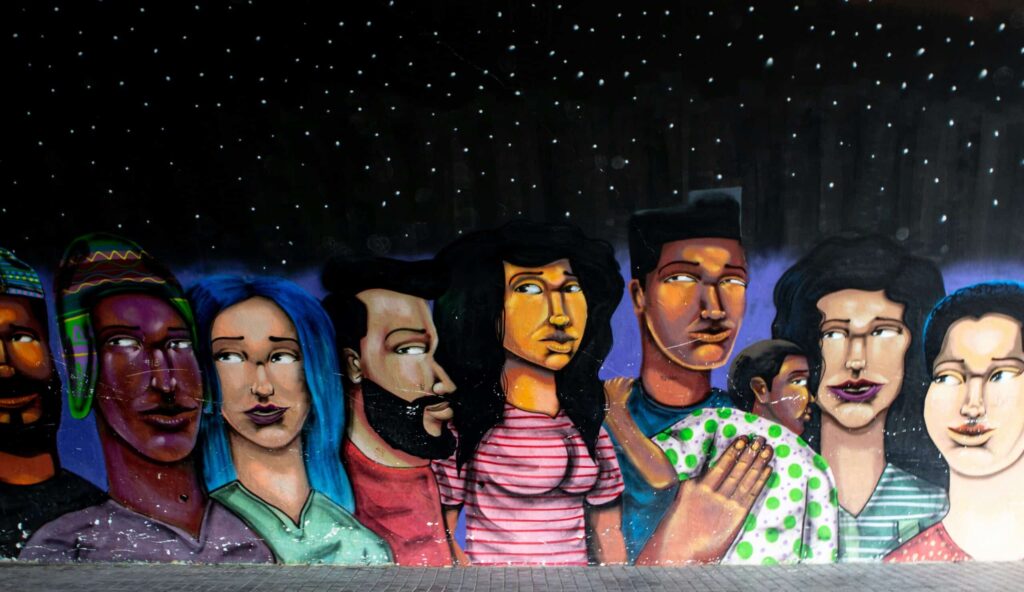
The current administration believes that even any mention of race, gender, disability, and sexuality is divisive, flagging words including “women,” “vulnerable,” “culturally appropriate,” “bias,” “Native American,” and many, many more, to be erased from grants, programs, policies, and even history.
The use of “DEI” (Diversity, Equity and Inclusion) as synonymous with incompetent and undeserved, and the effort to erase the contributions of some and the sins of others, is tragic and should be fiercely resisted and condemned by everyone in the general public — especially faithful Catholics.
It’s true that our dignity as humans does not stem from our identity in terms of race, gender, ability, or disability, but these characteristics are some of the ways that we each uniquely reflect the image of God. Discomfort with difference is an invitation to listen. It is an invitation to expand our notion of God, our understanding of the Body of Christ.
All of us, especially white Catholics, would do well to sit with our discomfort, to question it, to learn from it, and to repent for the sin of intentionally excluding certain children of God from meaningful participation in society. And then to roll up our sleeves and get to work building a kingdom of God where we can truly live in connection with one another.
ABOUT THE AUTHOR

Emily Cortina is a mother raising three bilingual, bicultural children alongside her Mexican husband. She advocates for transformative and restorative justice through her work in prison ministry and parish outreach at Kolbe House Jail Ministry in Chicago, Illinois.


