

All You Touch, You Change
In light of a second Trump term, I’m turning to writers and artists who live their values through their art. I seek inspiration and sustenance and courage to do the same—to let words change me and live with integrity and touch this bruised and burning world with bare, loving hands.
In 1934, T.S. Eliot visited Burnt Norton, a mansion that was set on fire by its British landowner in 1741, in the green and forested Gloucestershire, England. The man caught his mistress having an affair, killed her, then set the house on fire, killing himself. The garden survived, and that’s where T.S. Eliot stood, among its roses, feeling the haunting and heavy sorrow of what happened there. He wrote the poem “Burnt Norton” about it:
Time past and time future
What might have been and what has been
Point to one end, which is always present…
Footfalls echo in the memory
Down the passage which we did not take
Towards the door we never opened
Into the rose-garden.

T.S. Eliot felt within the rose garden a place forever changed by tragedy. The flowers and birds echo that sadness and at the same time remind us what could have been, and how the future could be different. I imagine time itself living in our flesh, writhing for redemption and hope which can only be birthed in us. In this present—this aching, cracking second—I write and sit in scatter-brained anxiety about the future of this country and world. Both what did happen and what could have happened exist right now. And what we might do in the future also exists right now.
The morning of election day, I read an email newsletter called Reimagined, written by Nicole Cardoza. She quotes from an article Octavia Butler wrote in 2000 in Essence magazine about writing dystopian science fiction. Butler writes about a time when a student asked her if she believed all the things in her novels would come true. The student was referring to the problems Butler writes about in Parable of the Sower and Parable of the Talents, which take place in a future of “increasing drug addiction and illiteracy, marked by the popularity of prisons and the unpopularity of public schools, the vast and growing gap between the rich and everyone else, and the whole nasty family of problems brought on by global warming.”
She tells the student that she didn’t make these problems up: “All I did was look around at the problems we’re neglecting now and give them about 30 years to grow into full-fledged disasters.” The student then asks: “So what’s the answer?” Butler says there isn’t one single answer. “Instead there are thousands of answers—at least,” she says. “You can be one of them if you choose to be.”
I read Parable of the Sower for the first time in 2020, when the world felt overwhelming and I felt guilty about my privilege. I opened the book, asking the same question as the student: So what’s the answer?
“All that you touch/You Change
All that you Change/Changes you,” says Lauren, the main character.
“The one thing that I and my main characters never do when contemplating the future is give up hope,” Butler writes in the Essence article. “In fact, the very act of trying to look ahead to discern possibilities and offer warnings is in itself an act of hope.”
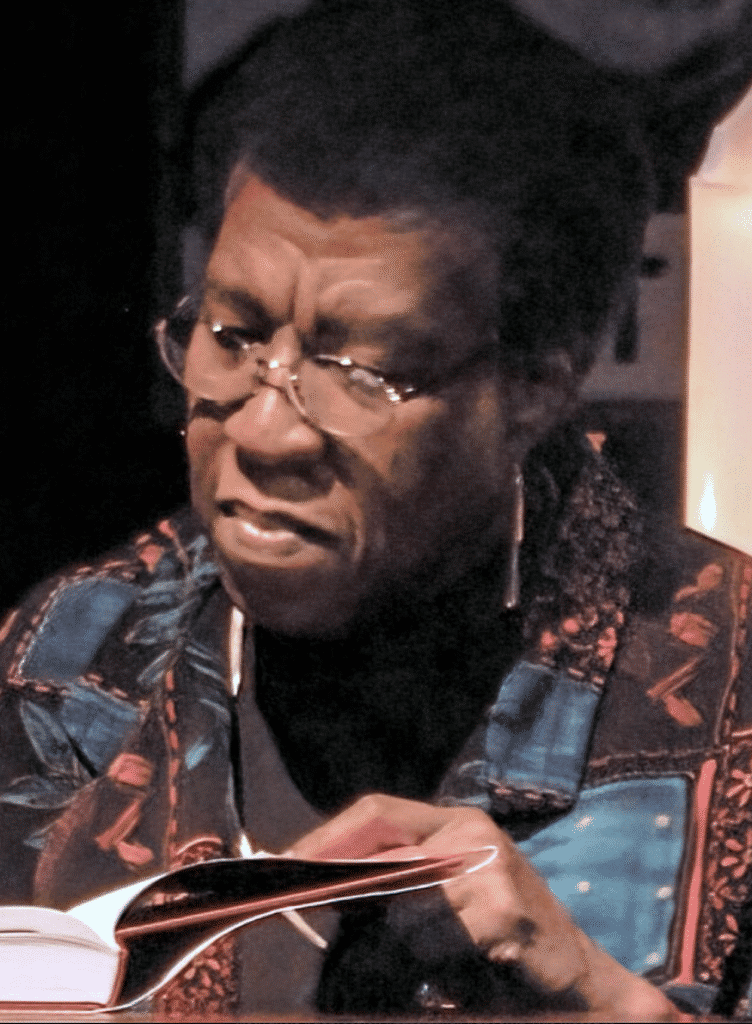
Yet Butler warns against “superstitious hope,” or predicting an “impossible state of permanent prosperity,” which has its roots in fear. Similarly, she writes that predicting doom might have more to do with our sorrow and depression than insights into real possibilities.
Being an answer, if we choose, means changing; it means taking responsibility. Being an answer means being in community with all the other thousands of answers. It means discerning our next steps along with God and taking our lives, and the future, and hope, seriously. We take turns being prophets. Burnt Norton is a changed place because T.S. Eliot visited and wrote about it and was a witness to sorrowful resurrection. Our minds are changed because of Octavia Butler’s novels that help us imagine new possibilities. All that you touch you change.
Today I’m in a rainy rose garden in my head, seeing all around me a world that cries out for redemption. I hear repeated words that in Christ, all things are possible; in Christ, all things are possible. We birth God in that place of rot and possibility. A thousand answers, a thousand beating hearts, a world that is forever changed by our touch.
ABOUT THE AUTHOR

Cassidy Klein is a journalist, writer, and editor based in Chicago. She has worked as an editorial assistant at Sojourners magazine and U.S. Catholic magazine. She grew up in Denver, Colorado and studied journalism and philosophy at PLNU in San Diego. Find more of her work at cassidyrklein.weebly.com.


One Comment
Comments are closed.