
Pilgrimage Part II: La Mama Appears
This is Part II of a two-part story. Click here to see Part I.
The night I missed the pilgrims’ departure to honor the Virgen de Urkupiña, I imagined the procession getting further and further away… So I tried to pull the story of her appearance closer to me, but the various accounts I had read offered few details. Here is my own rendering:
In the hills outside of Quillacollo, a young girl tended her family’s goat herd. One day, a beautiful lady with a baby in her arms spoke to the girl in her own Quechua language. La mamita, or “little mama,” as the girl came to call her, kept this child company in her long solitary hours as the baby boy slept and learned to crawl on the grassy hillside. One afternoon, as the baby dozed on the girl’s lap, he suddenly startled awake, eyes wide, but not tearful. The girl giggled as she pulled the boy closer. “Mamita, he hears rumbling in my belly!” It was true that the little girl rarely even carried a crust with her to her day’s work, yet she never complained.

As the sun began its descent that afternoon, the lady said to the girl, “Come, let’s play a game. Let’s see how many rocks you can carry home in this sack of yours. Then tomorrow, you can tell me how strong you were!” The pair laughed together as they hastily filled up the empty sack. As the girl marched off in front of her herd, she turned back to make a show for Mamita in the distance, flexing her arms.
The girl skipped without hurrying toward home, despite the heft of her sack. It was quite dark, and she was surprised when her mother grabbed and jostled her shoulder, demanding to know where the girl had been. The sack fell to the ground, spilling not stones, but as many silver pieces as stones there had been. That night, the girl slept with a full and warm stomach.
But her parents worried. They did not raise their girl to lie, and she was too unworldly to have stolen the coins. Who was this “beautiful lady”? The next day her parents and the village elders accompanied her to the hills, but the girl ran ahead, eager to find her Mamita y niño. When the girl spotted them, she ran back to the others and turned around pointing and shouting, “jaqayman, urqupiña!” “She is already on the hilltop!” The lady vanished before they could reach her. But once they descended, a statue of la mamita y el nino was found in the spot where they first appeared. Thus, the Virgen de Urkupiña came to be known by the words of this unnamed girl.
In the morning light, my host Ely found me still in bed. While not Catholic, she understood something about broken dreams, and the power of a mother who appears to the anawim, the poor and lowly ones. She took me to the market and instructed me to buy flowers, the loveliest of calla lilies. Soon afterward, her friend Ángel was driving us to Quillacollo. In the absence of my Christian pilgrims, Ely became my priest, instructing me in the rituals to come. At the pristine chapel in the town plaza, Ely gave me scissors to cut the string which held the bouquet. I would place the flowers one by one, among the countless dozens already at Our Lady’s feet, asking to be freed from all that bound me. Ángel, Ely, and I trudged through the crowds in the city center, past those selling every miniature and replica imaginable – unending rows of plastic babies, cars, houses, frogs spilling coins from their mouths, as well as chickens and roosters, which apparently signified love.
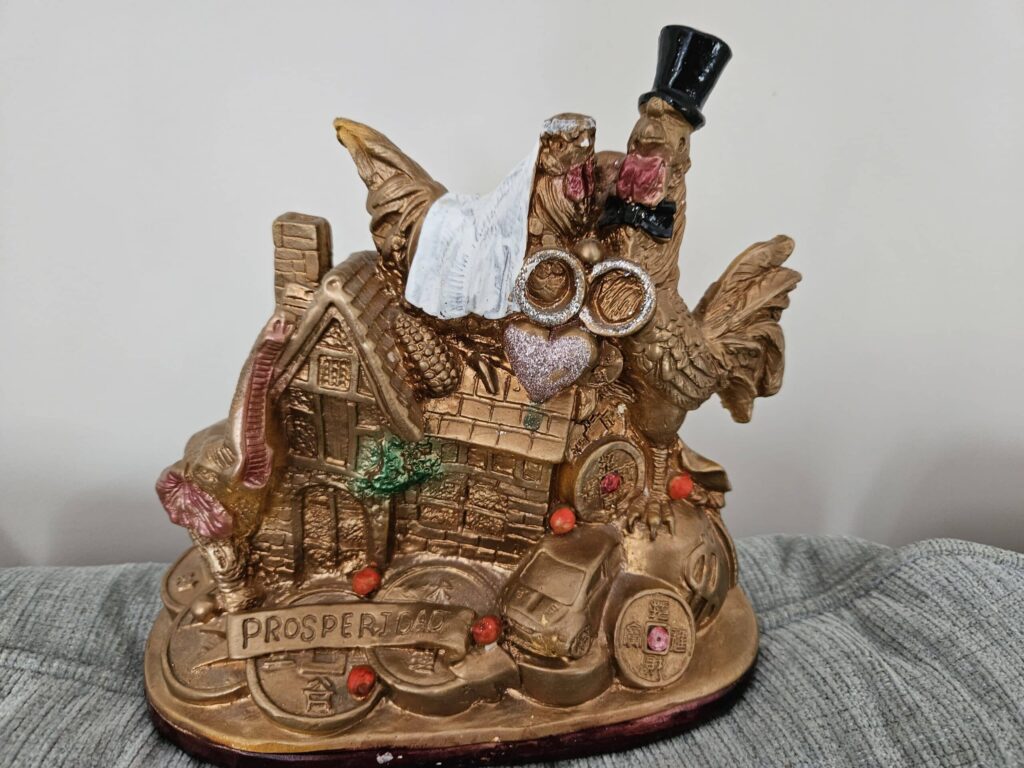
Without my seeing, Ángel and Ely purchased their desire for me, a gold painted statue montage like none other: A huge house and car resting on top of a pile of coins with a chicken and rooster in wedding attire perched on top of the roof. “Prosperidad” read the banner at the bottom. Did I blink in wonderment, or to keep the tears at bay? Where I only dared hope to mitigate future disaster, they could see a bright future for me. Moreover, they believed I deserved it and weren’t afraid to ask for it on my behalf. Before I could refuse, they sat me down in front of an indigenous priest, who blessed the object – and me. Incense rose; confetti fell. “Buen hora,” he said, looking into my eyes. “Godspeed. Blessings on the journey ahead.”
When we reached the hilltop where the Santuario de Virgen sits, Ely and Ángel waved me on to the small, grotto-like edifice, their courier quest complete. Inside was a dim swarm of bodies and melting vigil candles, and the sweat and smoke of the intentions they carried. These were the only visible signs I saw of la Virgen. It was enough. I lit my candles, murmuring prayers for people far away. I had not one personal petition remaining.
Mountaintops are notorious for draining people of all desire except that of staying on the mountaintop. Forever. It is not so bad having to descend to the rest of your life, though, when your priest and angel are outside waiting for you.
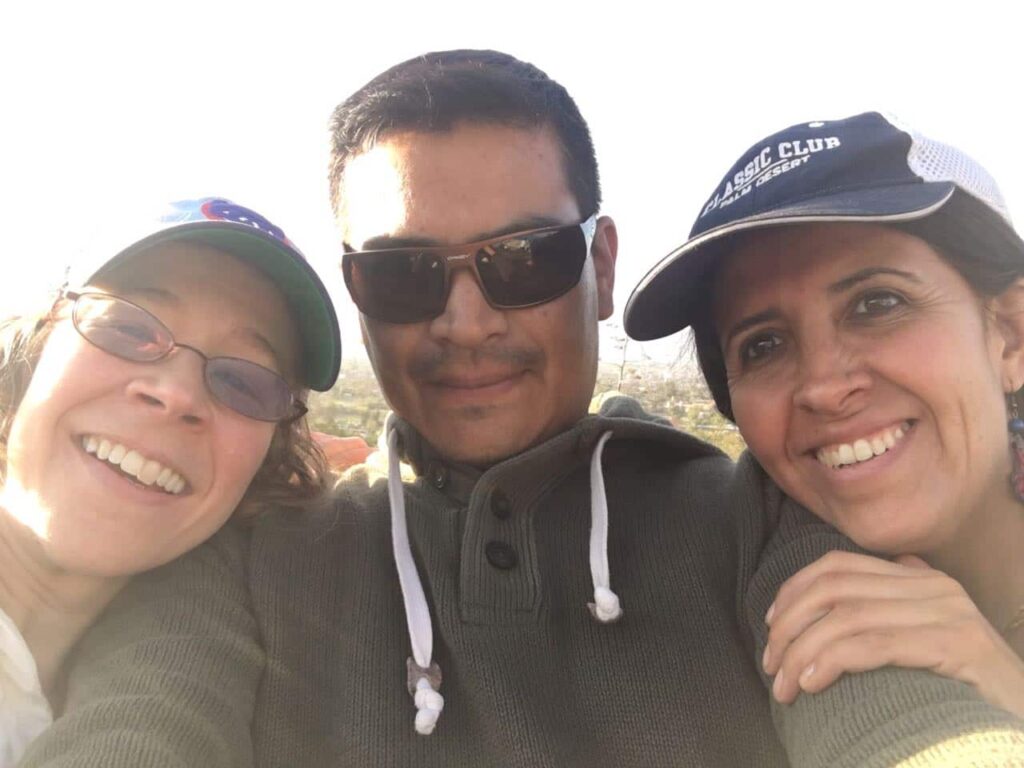
Hasta la próxima, Mamita. Y gracias por cuidar de tus hijitas.
Until next time, Mommy. And thank you for taking care of your little girls.
ABOUT THE AUTHOR

Angela Paviglianiti was ruined for life in the Jesuit Volunteer Corps around the turn of the century. She is what happens when you mix women’s studies, social work, and seminary. Angela is indebted to Ignatius of Loyola and Dorothy Day, although she probably wouldn’t have gotten along with either of them. She still believes in fairies, and the Gospel according to you and me and us.


